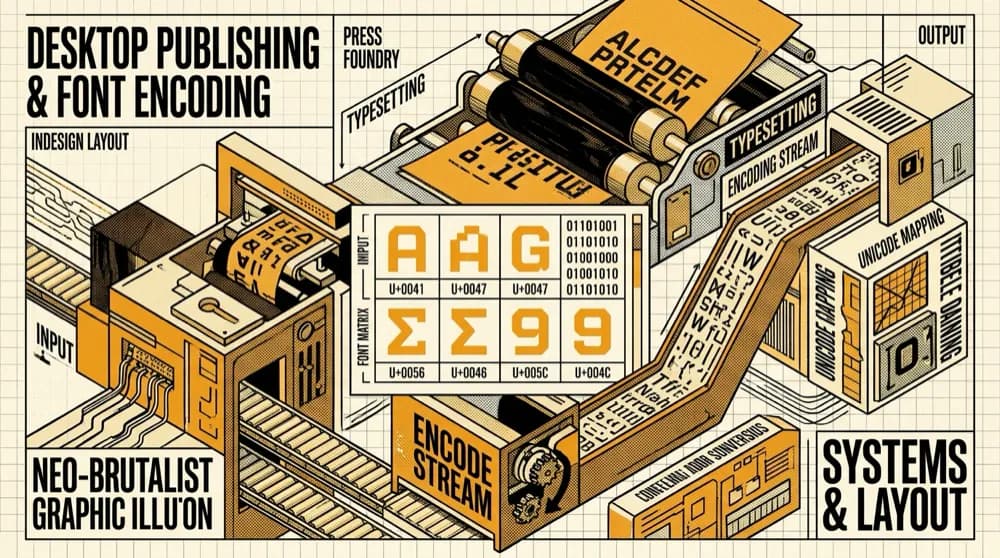
Desktop Publishing (DTP) Font Architecture: Solving Legacy Typography InDesign Bottlenecks
Overcome missing glyphs, broken ligatures, and PageMaker to InDesign migration bugs with automated bidirectional encoding converters and OpenType typography.
A comprehensive deep dive into legacy ASCII-mapped Indic font encodings, remap matrices, ligatures, and automated conversion pipelines to the universal Unicode standard.
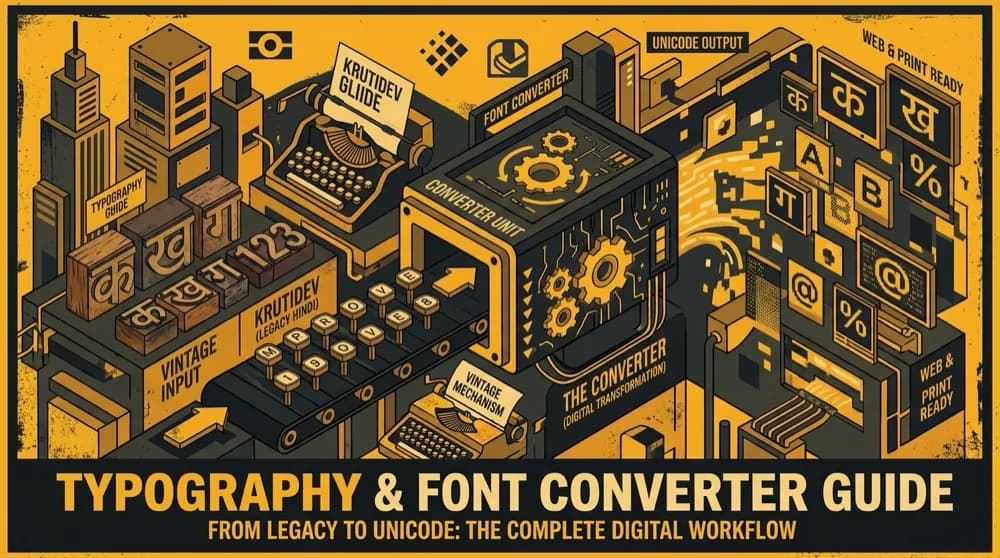
Before the universal standardization of Unicode in operating systems and web browsers, typing in Indian and South Asian languages was fundamentally an act of typographic trickery. Starting in the late 1980s and through the 1990s, desktop publishing systems, newspapers, and government departments required Indian scripts such as Devanagari, Bengali, Tamil, Telugu, and Gujarati. However, computer architectures at the time strictly supported 8-bit character sets (ASCII and extended ASCII), reserving 256 code points primarily designed for Latin alphabets.
To overcome this barrier, software developers and type foundries invented custom legacy 8-bit glyph fonts. The most famous of these include Kruti Dev and Devlys for Hindi, Bijoy (SutonnyMJ) for Bengali, Bamini for Tamil, Anu Script for Telugu, and Shree Lipi across multiple scripts. Rather than creating a linguistic encoding, these fonts simply overwrote standard English keyboard glyphs with Indian script shapes. When a user pressed 'd' in Kruti Dev, the screen displayed 'क'; pressing 'k' produced the vowel matra 'ा'.
While legacy fonts enabled local printing on dot-matrix and laser printers, they introduced severe systemic failures as digital technology advanced into the internet era:
The Unicode Consortium assigned distinct, semantically meaningful code point blocks for every major world writing system. For instance, Devanagari occupies the block U+0900 to U+097F, while Bengali occupies U+0980 to U+09FF. In Unicode, every character carries semantic identity regardless of which font or visual styling is applied.
Under Unicode, the letter 'क' is always character code U+0915, whether displayed in Mangal, Noto Sans Devanagari, Arial Unicode MS, or Kokila. A smartphone, a Linux server, and an Apple tablet all parse the exact same underlying character stream seamlessly.
Converting millions of legacy documents into modern Unicode is not a simple 1-to-1 character lookup. Indic scripts are phonetic abugidas where consonants carry an inherent vowel, and complex ligatures (samyuktakshars) change form dynamically. The conversion pipeline operates in four distinct algorithmic phases:
Legacy fonts frequently distributed diacritics across multiple non-standard keystrokes. For example, in Kruti Dev, the half-r (Reph, as in 'धर्म') is typed after the consonant with the key 'Z', whereas in Unicode phonology, the Reph is logically positioned before the consonant (र् + म). The converter must look ahead and reorder these characters prior to string replacement.
In Devanagari legacy fonts, half-letters like 'क्' (k) or 'स्त' (st) had dedicated single glyph IDs on the keyboard. A comprehensive lookup matrix translates multi-byte legacy glyph tokens into standard Unicode sequences containing the explicit virama (halant, U+094D).
Perhaps the most notorious challenge in Indic font engineering is the short 'i' vowel matra (ि). In visual printing, the curve of 'ि' appears to the left of the consonant (as in 'कि'). In legacy typewriter layouts, typists physically typed the matra key before the consonant. However, Unicode adheres strictly to spoken phonetic order: the consonant comes first, followed by the combining vowel sign (क + ि). Our conversion engine dynamically detects all preceding matra marks and shifts them behind the host consonant or consonant cluster.
Perso-Arabic loanwords with under-dots (Nukta), such as 'फ़', 'ज़', and 'ख़', are normalized into their single-character precomposed Unicode points (e.g., U+095E) or canonical decomposing pairs to ensure strict compatibility with modern search indexing algorithms.
When migrating old archives, books, or legal transcripts from Krutidev or Bijoy into modern formats, keep these actionable guidelines in mind:
Overcome missing glyphs, broken ligatures, and PageMaker to InDesign migration bugs with automated bidirectional encoding converters and OpenType typography.
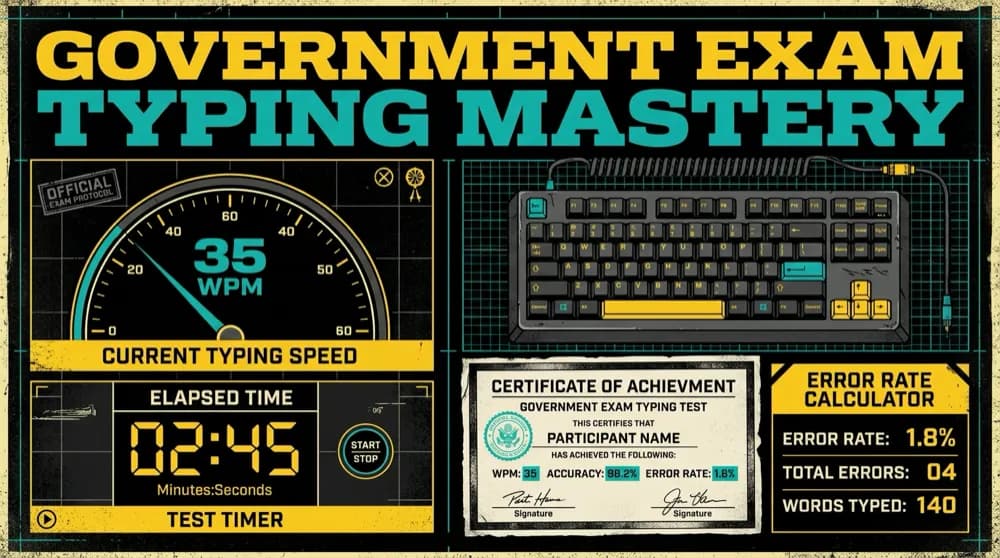
Proven benchmarks, error calculation formulas, half-mistake vs full-mistake evaluation rules, and a 30-day preparation roadmap to pass government typing skill tests.
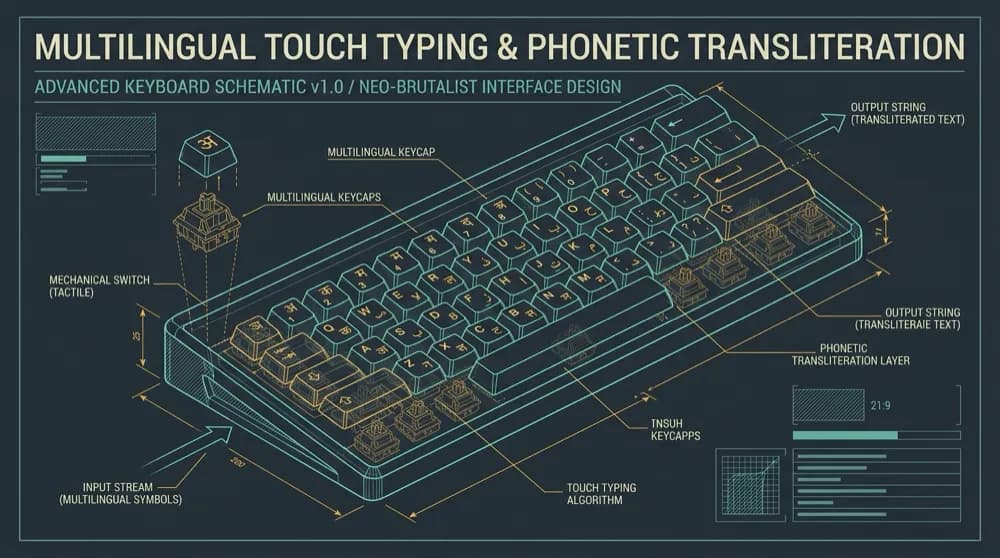
Explore how modern phonetic transliteration algorithms differ from official Inscript layouts, enabling fast, intuitive typing across Hindi, Bengali, Tamil, Russian, and Arabic.